

Not every player who enters a casino or launches a betting app carries the same neurological toolkit. Some walk away the moment their budget runs out, while others remain locked in despite every rational signal screaming for an exit. The difference is not simply a matter of willpower or moral character. It sits deep inside neural circuits shaped by genetics, early development, neurotransmitter balance, and years of behavioral reinforcement. Understanding why certain brains have a harder time pressing the stop button is one of the most consequential questions in modern gambling research, and the answers reach far beyond the casino floor.
The Braking System: How Inhibition Works in the Brain
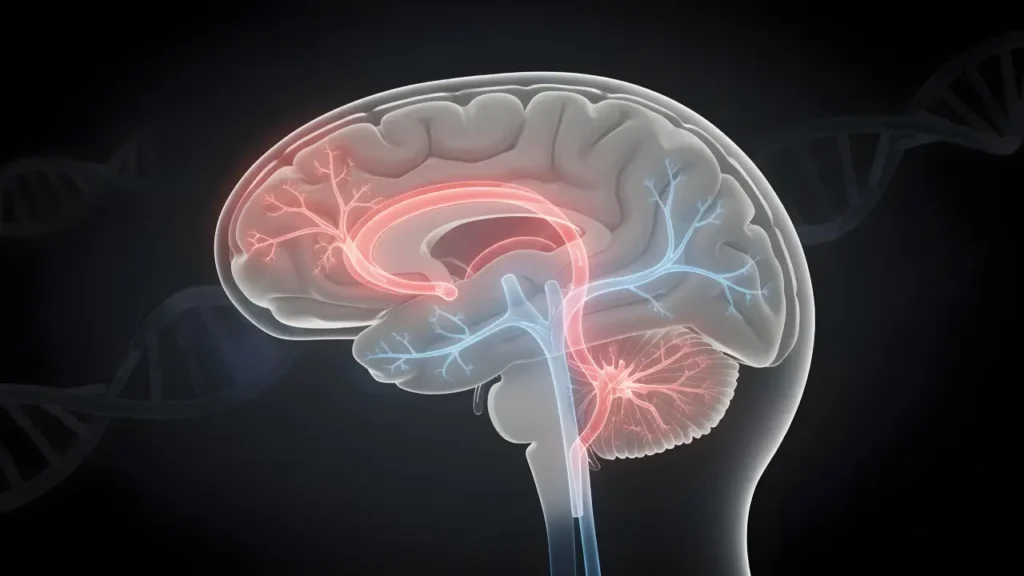
Every voluntary action begins with activation, but just as important is the ability to cancel or withhold a response. Neuroscientists call this response inhibition, and it relies on a tightly coordinated network centered in the prefrontal cortex. This network’s efficiency also degrades under sustained stimulation, as detailed in the neuroscience of cognitive fatigue and the tilt state during long sessions.
Key brain regions involved in stopping
- Right inferior frontal gyrus (rIFG) acts as the primary “brake pedal.” Damage or reduced volume here is consistently linked to impulsive behavior across clinical populations.
- Pre-supplementary motor area (pre-SMA) helps prepare the stop signal and coordinate timing between intention and inhibition.
- Subthalamic nucleus (STN) receives rapid input from the rIFG and sends a global pause signal to motor output, effectively halting an action already in progress.
- Anterior cingulate cortex (ACC) monitors for conflict between competing responses and flags situations where inhibition is needed.
Together, these regions form what researchers sometimes call the “stopping network.” Functional neuroimaging studies using the Stop-Signal Task, a standard lab measure of inhibitory control, consistently light up this circuit in healthy adults making successful stops. Individuals with stronger white matter connections between the rIFG and the STN show faster stop-signal reaction times, meaning they can abort an action more quickly once they realize it is unwise.
When this network fires efficiently, a person can override an impulse within approximately 200 to 250 milliseconds. In the context of gambling, that fraction of a second is the difference between clicking “bet again” and pausing to reconsider. But this system does not perform equally in everyone, and its efficiency depends on structural, chemical, and developmental factors.
The Chemistry of Control: Serotonin, Dopamine, and GABA
Impulse control is not a single-neurotransmitter affair. At least three major chemical systems interact to determine how well the braking network functions. These neurochemical dynamics help explain how emotions drive casino decision-making and risk-taking in real time.
| Neurotransmitter | Role in Impulse Control | What Happens When It’s Low |
|---|---|---|
| Serotonin (5-HT) | Promotes patience, delayed gratification, and behavioral restraint | Increased impulsivity, higher risk-taking, difficulty waiting for larger future rewards |
| Dopamine (DA) | Drives reward-seeking and motivation; modulates the “go” signal | Reduced motivation in some pathways, but elevated dopamine in the mesolimbic system amplifies reward-chasing |
| GABA | Primary inhibitory neurotransmitter; calms neural excitability across the cortex | Reduced cortical inhibition, higher neural “noise,” weaker top-down control over impulses |
The serotonin-impulsivity link
Among these, serotonin has the most robust evidence base in relation to impulse control. Studies using tryptophan depletion, a method that temporarily lowers serotonin levels, consistently show that participants become more impulsive on laboratory gambling tasks. They choose smaller immediate rewards over larger delayed ones, and they have more difficulty stopping a response once initiated. Conversely, medications that increase serotonin availability, such as selective serotonin reuptake inhibitors, have shown modest but real effects in reducing impulsive gambling behavior in some clinical trials.
Dopamine’s dual role
What makes the serotonin system particularly relevant for gambling is that it governs the ability to tolerate delay. In a casino environment, every spin, every hand, and every bet is an invitation to act now rather than wait. A brain with lower baseline serotonin function finds the pull of immediate action significantly harder to resist, not because the person lacks intelligence or awareness, but because the neurochemical substrate for patience is operating at a disadvantage.
Dopamine complicates the picture further. While it is essential for motivation and learning, an overactive mesolimbic dopamine pathway can make reward cues disproportionately salient. This is why some individuals on dopamine agonist medications, commonly prescribed for Parkinson’s disease, develop compulsive gambling as a side effect. Their braking system has not changed, but the accelerator has been pushed much harder, overwhelming the prefrontal circuits tasked with saying no. This clinical finding has become one of the strongest pieces of evidence that gambling behavior is not purely a function of choice, but also of underlying neurochemical balance. It demonstrates that tipping a single parameter in the dopamine system can convert a non-gambler into a compulsive one, even without any change in personality, knowledge, or life circumstances.
Genetics and Individual Vulnerability
Not all impulsivity is acquired. Research in behavioral genetics has identified several gene variants that influence how efficiently the inhibitory network operates.
Genes that matter
- DRD2/DRD4 variants affect dopamine receptor density in the striatum. Certain polymorphisms are associated with reduced sensitivity to natural rewards, which can push individuals toward more intense stimulation, including gambling.
- 5-HTTLPR (serotonin transporter gene) influences how quickly serotonin is cleared from the synapse. The short allele variant has been linked to higher emotional reactivity and reduced impulse control, particularly under stress.
- COMT Val158Met affects dopamine metabolism in the prefrontal cortex. The Val/Val genotype breaks down dopamine faster, potentially reducing the sustained prefrontal activation needed for complex decision-making.
- MAO-A variants influence the breakdown of both serotonin and dopamine, with low-activity forms associated with higher impulsivity across multiple behavioral domains.
It is critical to emphasize that no single gene “causes” problem gambling. These variants contribute to a probabilistic landscape. A person carrying several high-risk alleles may never develop a gambling problem if protective environmental factors, such as stable upbringing, strong social bonds, and limited early exposure to gambling, are in place. Genetics loads the gun, but environment pulls the trigger.
Developmental Windows: Why Early Experiences Shape Adult Control
The prefrontal cortex is one of the last brain regions to fully mature, a process that continues into the mid-twenties. This means that adolescents and young adults are operating with a braking system that is literally under construction, while their reward system, centered in the ventral striatum, is already fully operational.
Critical developmental factors
| Factor | Impact on Impulse Control |
|---|---|
| Early exposure to gambling (before age 15) | 2 to 4 times higher risk of developing problem gambling later in life |
| Childhood adversity and chronic stress | Elevated cortisol can impair prefrontal development, weakening long-term inhibitory capacity |
| Substance use during adolescence | Alcohol and stimulants during the developmental window can cause lasting changes to dopamine circuitry |
| Positive parenting and secure attachment | Strengthens prefrontal connectivity and builds internal models of delayed gratification |
The imbalance between a mature reward system and an immature control system creates a window of heightened vulnerability. Research on adolescent gambling shows that young players are more likely to chase losses, less likely to set spending limits, and more prone to developing habitual patterns that can persist into adulthood. The neural pathways strengthened through early repetition become the default circuits the adult brain relies on, making early gambling habits disproportionately sticky compared to those formed later in life.
These developmental realities carry direct implications for gambling policy. The case for strict age verification and limited advertising exposure during formative years is not a moral argument alone. It is grounded in the biology of a brain that cannot yet fully weigh long-term consequences against immediate reward.
Implications for Players, Operators, and Researchers
Recognizing that impulse control varies biologically across individuals reframes the conversation around problem gambling. It shifts the focus from blame to understanding, and from generic advice to targeted intervention.
What this means in practice
- For players: Self-awareness is the first line of defense. Those with a family history of addiction, a tendency toward impulsive decisions in daily life, or early gambling exposure may benefit from preemptive tools such as deposit limits, session timers, and self-exclusion programs, not as signs of weakness but as rational adaptations to their specific neurobiology.
- For operators: Responsible design should account for neurological diversity among users. Features like mandatory cooling-off periods, behavioral analytics that detect rapid escalation, and clear opt-in self-limitation tools are not regulatory burdens. They are investments in long-term platform sustainability and user trust. Many of these safeguards already sit within the broader framework of risk management in the casino industry, but they are often underutilized for neurological protection.
- For researchers: The intersection of neurogenetics, cognitive neuroscience, and gambling behavior remains rich with open questions. Longitudinal studies tracking how genetic vulnerability interacts with platform design and regulatory environment are essential for evidence-based policy.
The science is clear that impulse control is not distributed equally, and that the reasons for this inequality are biological as much as they are psychological or social. Acknowledging this does not excuse harmful behavior, but it does demand a more sophisticated response than simply asking people to try harder. A system designed for the average brain will inevitably fail the brains at the edges, and it is precisely those individuals who need the most thoughtful design, the most robust protections, and the most compassionate understanding of what their neurobiology is actually doing when the next bet feels impossible to resist.
